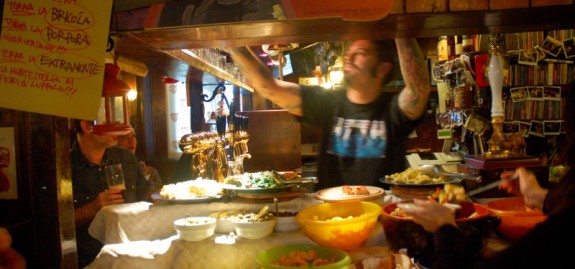
If you couldn’t make it to the Slunce ve skle beer festival last Saturday in Plzeň, here’s a YouTube video from the day. In a word: Awesome.
Author Archive
The New Dožínkové Pivo
As a follow-up from last week’s post on two new wheat beers in the Czech Republic, I’ve got more details about the new Dožínkové pivo appearing at outlets of Heineken Česká republika around the country. And no, it’s not exactly from Krušovice. And it wasn’t brewed at Starobrno, either. Read the rest of this entry »
A New Czech Wheat Beer — or Two

You’re walking down the street in Prague, completely minding your own, when your eye hangs on a sign announcing a new beer. What stops you is an apparent error in the picture: instead of barley, the poster is adorned with what seems to be wheat.
Called Dožínkové pivo, the Czech Republic’s newest wheat beer started to show up at pubs around the country this week. There are two surprising things about the appearance of a new wheat beer in Bohemia, not the least of which is the brewery making it. (Drumroll, please…)
The Growing Fourth Pipe Phenomenon: Klášterní Pivnice

The phenomenon of the čtvrtá pípa — or fourth pipe — just keeps on growing: slowly but steadily, more and more pub owners in Prague are switching over from monopolistic suds to beers from independent brewers, often on a tap they own themselves, rather than the three taps installed and owned by a major brewing group. It’s an interesting concept: when I wrote about it earlier this year for Prague Monitor Magazine, the term earned a note at the Schott’s Vocab weblog (“a miscellany of modern words and phrases”) at the New York Times.
Max Bahnson just covered two new čtvrtá pípa pubs at his Pivní filosof weblog, with not such great results. But there’s another fourth pipe pub which is a total winner: the Klášterní pivnice near Letná in Prague 7.
Hotel Beers: Pivovarský dům in Bottles and the Return of Svatý Tomáš

In this part of the world, three of the most important words in contemporary beer culture are draft, draft and draft, with bottled beers making up a smaller (though growing) percentage of sales. For a long time, one of the only bottled beers from Prague’s Pivovarský dům brewpub was their Champagne-like Šamp, made off-site at a local producer with excess capacity. But now, the Czech capital’s revered brewpub is offering its classic dark lager in swing-tops.
But there’s a catch.
From the Archives: On Balling, Mozart, and Oat Beers Where the Sun Don’t Shine

When exactly did Pilsner-style pale lagers conquer central Europe, replacing the earlier styles that had existed here for centuries? Where did they get their foothold, when, and for what reasons? I don’t have the answers yet, but I’ve recently been working in the archives of the Czech National Library, reading a bit more about eighteenth- and nineteenth-century brewing in the region. And just yesterday I found an interesting quote in Carl Balling’s Die Gährungschemie (3rd ed., 1865), regarding beers made from oats.
The Return of Krušovice Černé

Although I believe in the importance of local ownership for breweries, I’m not totally convinced that that local owners are always better owners. Sometimes local owners can screw things up. Sometimes foreign owners can improve things. Look at what happened with Krušovice Černé, the legendary black lager from the brewery once owned by Holy Roman Emperor Rudolph II.
The Czech Republic’s New Beer Map

When my wife and I were preparing our research trips for Good Beer Guide Prague and the Czech Republic, we first had to make a map. We came up with a list of breweries based on information in the Pivovarský kalendář, a publication of the Czech Research Institute of Malting and Brewing, and cross-referenced it with the breweries’ own web sites. Once we had all the addresses, we bought a regular map of the Czech Republic and marked the breweries on it with little red dots. That homemade Czech beer map became an invaluable research tool, helping us to visit every brewpub in the Czech Republic at the time and most of the country’s industrial brewers.
Now a local publisher has put out a professional map of all the breweries in the Czech Republic.
A Celebratory New Strong Beer From Rebel

Czech brewers have a tradition of making special beers to celebrate special anniversaries. A common way to commemorate the date is to work the founding year into the recipe of the beer itself.
For example, to celebrate the 325th anniversary of Moravia’s Pivovar Vyškov, brewmaster Dušan Táborský created an excellent strong and hoppy pale lager, Jubiler, brewed at an original gravity of 16.80° Plato, to reflect the brewery’s founding year of 1680.
Other Czech beers have taken a similar path.
A Visualization of Beer Consumption By Country
Each year, the Czech Republic consumes the most beer per capita, regularly hitting around 160 liters for every Czech man, woman and child. But how does that compare to other countries?
The visualization above is part of a 12-nation comparison from Snippets.com, and re-posted here with kind permission. Each glass depicts the relative annual beer consumption per person for the specified countries, using data from a 2004 report by the Japanese brewer Kirin, whose retro recipes we noted earlier.
Here’s how the 12 nations stack up: