Some corrections, comments, clarifications and addenda to the Czech entries of The Oxford Companion to Beer:
“The majority of beer sold in the Czech Republic is relatively light lager classified as výcepní [sic], these are brewed from original gravities between 8° Plato and 12° Plato” (page 277).
Correctly spelled “výčepní,” this category of beer has long had an upper limit of 10° Plato. Czech beers of 11° and 12° Plato compose a different legal classification, called “ležák.” (Source: Czech State Agricultural and Food Inspectorate.)
“Beers having more than 5.5% ABV are referred to as special [sic] Speciální” (page 278).
Called “speciální pivo” (or “speciál”), this legal classification is for beer “with an original gravity of 13° or higher.” The amount of alcohol has no bearing here. (Source: as above.)
“Budvar… has 5% alcohol by volume and 20 units of bitterness” (page 191).
According to the company’s press spokesman in the Czech Republic, Budweiser Budvar’s 5% alcohol lager has 22.5 units of bitterness, not 20.
In the entry for “Bohemian Pilsner,” the book states that for Czech versions, “the brewing grists are invariably 100% pilsner malt” (page 140).
Actually, many breweries in the Czech lands use a small portion — about 1% — of caramel malt in their premium pale lagers, or “Bohemian Pilsners.” (Source: interviews with Czech brewers and brewery consultants.) While 100% pilsner malt might be a traditional grist for a Czech pale lager, it is not “invariably” the case today.
“Throughout the Middle Ages, the general populace, from peasants to kings, produced beer within their own households” (page 277).
This seems to contradict Ludvík Fürst’s 1941 monograph Jak se u nás vařilo pivo, which notes that brewing was outlawed or banned for the general public in the Czech lands during much of the Middle Ages. For example, St. Adalbert (956–997) banned brewing under the threat of excommunication, a decree which lasted over 200 years until it was lifted by Pope Innocent IV at the urging of the first King Wenceslas, Václav I (1205-1253).
At this point, things actually went from bad to worse, as brewing in all forms started to become subject to the Mílové Právo, or Mile Right, which granted noblemen or small groups of burghers in many Czech towns and cities an exclusive monopoly on producing beer (and occasionally other products) within a radius of one Czech “mile” — a distance equal to about 7,530 meters, or 4.6 miles by our measure. Thus, brewing was prohibited — “occasionally under the punishment of death,” as Fürst notes — for everyone except the holders of the Mile Right, generally within an area of about 66 square miles in each location.
Pivovary.info’s piece on the Mílové Právo notes that the monopoly was instituted in Opava in 1224, in Olomouc in 1230, in Kroměříz in 1240, in Brno in 1243, in Trutnov in 1260, in Louny in 1265, in Prague in 1278, and in České Budějovice in 1351, among other settings. This ban lasted for much of the late Middle Ages, from the early 13th century until about the late 15th century, though the law continued to exist in some areas and in some form until its definitive abolition in 1788.
Meanwhile, in the countryside, “the right to brew beer for members of households was gradually transferred to manor houses,” writes Fürst, noting that this exclusive brewing right of local lords was — later — explicitly confirmed by Vadislav II in the year 1485.
Jak se u nás vařilo pivo does include some evidence of home brewing by the Czech populace during the Middle Ages, but, given the numerous prohibitions on brewing and the area’s many brewing monopolies, it seems incomplete — if not downright incorrect — to claim that brewing in households was commonplace “throughout” the Middle Ages here.
“Bohemian brewing became famous in the 13th and 14th centuries when some of the aforementioned towns were granted brewing privileges and banlieu [sic] rights (which meant that within a certain distance of the town only beer brewed by the town’s burghers could be legally sold)” (page 140).
It is not clear why we are using a French word here, nor why that word is misspelled — it should be banlieue — though in any case this is not exactly what was meant by the Mile Right, as noted above. Under the Mile Right, it was not merely forbidden to sell beer from somewhere else: it was against the law, sometimes as a capital offense, for anyone but those holding the Mile Right “to brew beer, produce malt, or open a tavern.” Moreover, it should be noted that this right was not enjoyed equally by all burghers in each town: “The older, established burghers later claimed this right for themselves and did not grant it to the new [burghers].” (Source: Jak se u nás vařilo pivo.)
“Martin Stelzer, founder of the Burgher’s [sic] Brewery of Pilsen” (page 408).
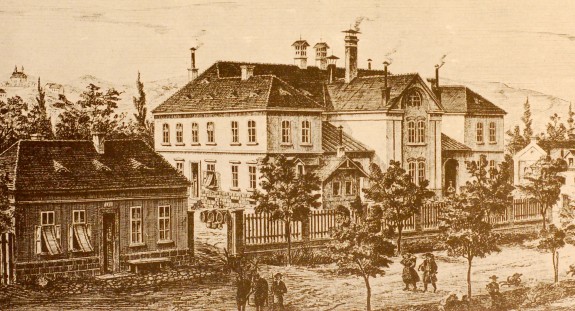
A celebrated local architect, Martin Stelzer was one of two principal builders of the Burghers’ Brewery in Pilsen, but it is wrong to call him a founder. Most importantly, Martin Stelzer was not among the twelve prominent Pilsen burghers who requested the construction of a new brewery on January 2, 1839. Nor was he one of the 250 Pilsen burghers who held brewing rights at the time of the brewery’s founding. (Source: Měšťanský Pivovar v Plzni 1842–1892). He might have been hired by the founders, but he was not a founder himself.
(Obviously, the correct spelling should be “Burghers’ Brewery,” as this is a plural possessive. This shows up again as incorrect on page 277, though it appears in a different incorrect form, as “Burgher Brewery,” on pages 74, 102, 393, 419 and 597, and is translated differently — and perhaps equally correctly — as “Citizens’ Brewery” on page 386.)
“Groll smuggled a Bavarian lager yeast across the border” (page 409).
According to the 1892 chronicle Měšťanský Pivovar v Plzni 1842–1892, “seed yeast (yeast, material) for the first batch and fermented wort were purchased from Bavaria.” There is no mention of Mr. Groll’s involvement.
More importantly, it was clearly not the case that lager yeast needed to be “smuggled.” The book notes that, by 1841, fully one-tenth of all breweries in the Czech lands were already using bottom-fermenting lager yeast (including one of the largest producers in nineteenth-century Bohemia, the Wanka brewery in Prague, just 57 miles away). Well before the first batch of Pilsner Urquell was brewed in 1842, the town of Pilsen was already “flooded” by bottom-fermented beer, as the founders of the brewery stated the situation in 1839.
“Smuggled” might be romantic, but it is clearly not accurate.
“A legend in Pilsen says the wrong type of malt was delivered to the brewery by mistake but this seems fanciful” (page 653).
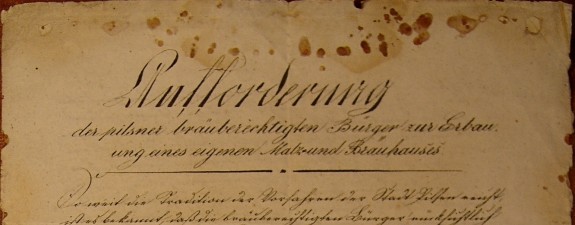
It most certainly is fanciful, as the original Burghers’ Brewery was constructed with its own malthouse on the premises, a crucial element from its initial concept. The title of the 1839 document which founded the brewery reads “Request of the Burghers with Brewing Rights for the Construction of Their Own Malt- and Brewhouse.” In it, the founding burghers’ fifth point highlights the importance of being able to produce their own malt, declaring that a brewer who would trust his barley and malt to someone else “threatens his capital with fire.”
This essential part of the brewery was even given priority in construction: “At the end of September, 1842, the whole brewery, interior and exterior, was completed, and because the malting had begun even earlier, brewing could begin without any further delay in early October.”
(Some background: in Czech, the main word for “brewer” is “sládek,” meaning “the man who prepares the malt,” or “maltster,” as for centuries here, the task of many brewers — like Mr. Groll — was, in large part, to make malt. This is still done today by the brewer Jaroslav Nosek at Pivovar Broumov, a small brewery which spends the bulk of its late spring and early summer malting its own barley for use in the coming brewing season.)
And in point of fact, the historical record clearly notes that the brewery’s very first load of “hard barley” — definitely not malt, and definitely not the wrong kind — “was purchased at the then-weekly market at an average price of 3 florins and 12 crowns.” (Source: Měšťanský Pivovar v Plzni 1842–1892.)
Martin Stelzer “toured Europe and Britain to study modern breweries” (page 653).
Strangely, The Oxford Companion to Beer’s previous entry does not even agree with this statement, noting on page 652 only that “Martin Stelzer was commissioned to design and build the new brewery. He traveled extensively around Bavaria,” period, with no mention of any trips elsewhere.
According to Měšťanský Pivovar v Plzni 1842–1892, the two architects who were hired to create the new Burghers’ Brewery both took trips to see bottom-fermenting breweries — though not to Britain. The builder František Filaus “made a trip around the biggest breweries in Bohemia which were then already equipped for brewing bottom-fermented beer,” while in December of 1839, Martin Stelzer “traveled to Bavaria, so that he could tour bigger breweries in Munich and elsewhere and use the experience thus gained for the construction and furnishing of the Burghers’ Brewery.”
More obviously, the goal of the new brewery — clearly stated in the founding document in 1839 — was to produce bottom-fermenting beer, also called “Bavarian beer.” Obviously, Mr. Stelzer would have been unlikely to find many producers of Bavarian lager in Britain in 1839.
This entry seems to be confused with the story of Gabriel Sedlmayr and Anton Dreher, who did travel around Britain visiting breweries a few years earlier.
“It’s more likely that Martin Stelzer brought back from England a malt kiln indirectly fired by coke rather than directly fired by wood. This type of kiln was used to make pale malt, the basis of a new style of beer brewed in England called pale ale. A model of a kiln in the Pilsen museum supports this theory” (page 653).
This is simply wild speculation. As noted above, the brewery’s own chronicle has no record of Martin Stelzer — one of the most prolific architects of his age, the author of hundreds of buildings in Pilsen — taking time off to travel all the way to Britain. Given his task — to construct a Bavarian-style, bottom-fermenting brewery — there would have been no reason to do so.
However, it is apparent that the Burghers’ Brewery was originally outfitted with a noteworthy kiln, whose description in Czech (“dle anglického spůsobu zařízený hvozd”) seems to make it clear that this was not, in fact, a kiln which had come from England, but rather “a kiln equipped in the English manner,” according to Kniha pamětní král. krajského města Plzně od roku 775 až 1870, an extensive chronicle of Pilsen published in 1883. (According to this book, this kiln was “vytápěný odcházejícím teplem z místnosti ku vaření,” or “heated by heat leaving the boiling room.”)
“Plzensky Prazdroj [sic],” page 654 and page 277.
A small mistake to outsiders, but technically a misspelling in local terms, as N and Ň (and Y and Ý) are considered different letters in Czech. (Strangely, The Oxford Companion to Beer itself spells the name correctly, as “Plzeňský Prazdroj,” on pages 74, 103, 140, 386, 651 and 652.)
At Budvar, “Soft brewing water comes from a deep natural lake beneath the brewery, using a well that dates back several thousand years,” (page 191).
The town of České Budějovice was founded in the year 1265 AD, though the Budvar brewery was only built in 1895, in a much younger northern suburb there.
A well is a man-made structure, “a shaft sunk into the ground in order to obtain water, oil or gas,” while “several” means “more than two but not many.” Thus, this passage reads as if part of a brewery from 1895 somehow dates from around 1000 BC, making it many centuries older than the arrival of the Celts in Bohemia, and thus one of the oldest man-made structures in the country. This is preposterous.
Budvar’s own claims for the age of its wells on its company website sound far more reasonable: “In 1922 the first artesian well was bored and after some further time an additional two artesian wells were also bored.”